
Overcoming tissue scattering in wide-field two-photon imaging by extended detection and computational reconstruction
Compared to point-scanning multiphoton microscopy, line-scanning temporal focusing microscopy (LTFM) is competitive in high imaging speed while maintaining tight axial confinement. However, considering its wide-field de…
Abstract
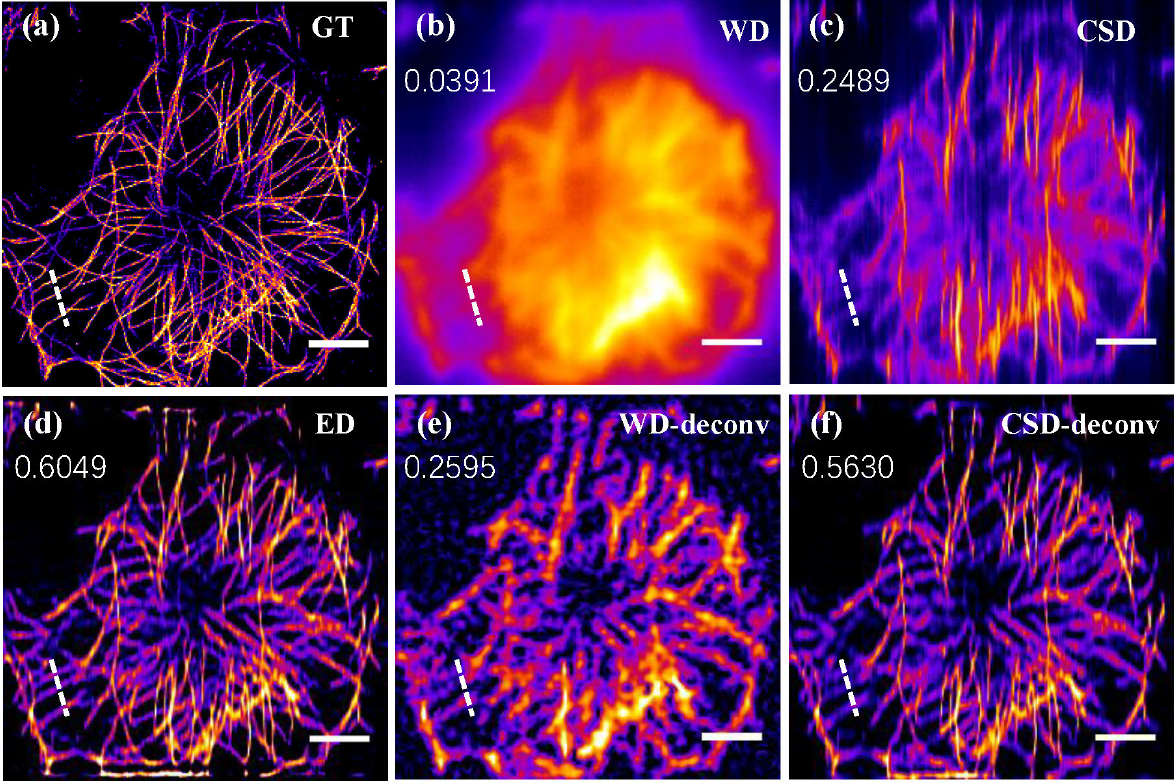
Compared to point-scanning multiphoton microscopy, line-scanning temporal focusing microscopy (LTFM) is competitive in high imaging speed while maintaining tight axial confinement. However, considering its wide-field detection mode, LTFM suffers from shallow penetration depth as a result of the crosstalk induced by tissue scattering. In contrast to the spatial filtering based on confocal slit detection, here we propose the extended detection LTFM (ED-LTFM), the first wide-field two-photon imaging technique to extract signals from scattered photons and thus effectively extend the imaging depth. By recording a succession of line-shape excited signals in 2D and reconstructing signals under Hessian regularization, we can push the depth limitation of wide-field imaging in scattering tissues. We validate the concept with numerical simulations, and demonstrate the performance of enhanced imaging depth in in vivo imaging of mouse brains.
Links
- Paper: https://doi.org/10.1364/OE.27.020117
- DOI: https://doi.org/10.1364/OE.27.020117
Recommended citation: Y. Zhang, T. Zhou, X. Hu et al. (2019). Overcoming tissue scattering in wide-field two-photon imaging by extended detection and computational reconstruction. Opt Express
Download Paper